Thursday, April 19, 2007

33 1/3 series

I have been reading pieces from the 33 1/3 series over the past couple weeks. It appears that the aim of this series is to devote each book to a single album. The authors range from scholars to musicians, such as Colin Meloy of the Decemberists. There is a decent blog for this series that can be searched for comments and reviews on specific books from the series. I had heard from numerous sources that the series was very hit and miss, but having liked the two that I have read so far, I can't say really. I was in Harvard Square a couple weeks ago and ventured into the Harvard Bookstore to check out which books from the series they had and ended up talking to a fellow there who has reportedly read 42 books so far. I asked him what he recommended and if he had also found the series to be inconsistent, to which he replied that it depended on what I was looking for from the books. Fair enough. These books are only about 150 pages or so each, so I think if you don't expect a major piece of heavily researched work here, you won't be too disappointed. Some of the books are mostly anecdotal, others more researched with interviews, and others still more referential, such as LD Beghtol's field guide to the Magnetic Fields' 69 Love Songs. So far I have read Ric Menck's book on The Byrds' The Notorious Byrd Brothers and the series' oddball novella by John Niven inspired by The Band's Music from Big Pink.

The piece on The Notorious Byrd Brother was the first of the series that I read and I found it to be a perfect blend of the authors anecdotes, history of the band, history of the making of the album, and a song by song critique of the album. I stayed up late one night finishing the book with my headphones on, reading Menck's commentary on each song and trying to identify aspects of the songs he was pointing out. I had previously thought that the Byrds' Fifth Dimension was their best album, but after really sitting and focusing on listening to the lyrics and the instrumentation more than I had before, I definitely see why this album is so significant. The studio effects produced for this album by Gary Usher are tremendous and, at the time, innovative. I am embarrassed to admit that I had not even noticed that the songs blend seamlessly into one another on this album until I read this book. One last thing, Ric Menck includes commentary on bonus songs that can be found on the most recent CD release of this album. This commentary includes a note about an intense 7 minute recording at the end of the album where you can listen to the band, especially Clarke and Crosby, get into one of the arguments that had been brewing for some time, which eventually led to Crosby leaving the Byrds. I am including this track with this entry, though you will have to skip to about the midway point (~6:41) to hear the Byrds' argument.
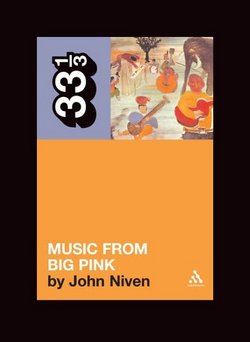
In contrast, the next book I read was John Niven's novella, which is the first of its kind in the 33 1/3 series so far. There are plenty of reviews of this story, so I am not going to say much here. (There is talk about making Niven's story into a film. ) I will admit that I would have preferred to read about Music From Big Pink in the same manner that I read about The Notorious Byrd Brothers . That not being the case though, the novella was still informative and, though fabricated, left me feeling more of an intimate connection with the Band through their fictitious drug-dealer than I imagine I would have received through a historically factual account of the Band during the making of their first album. Well, I guess that is a flimsy statement to make, though I nonetheless enjoyed reading John Niven's work. The story felt to me to be less concerned with learning about the Band via the narrator's connections and more about the relationship the narrator had with the music on the album. There are countless snippets of lyrics that continue to conjure memories for me, whether by their apt descriptions of relationships or events in my life or simply from having been the music in the back ground while driving down the road. Certain songs from Music From Big Pink remind me of spending time in New York state amidst a confusing relationship with an old friend who introduced me to the Band at her mother's house out in the country. Other tracks remind me of driving highway 81 along Virginia's Shenandoah mountains years ago alone in my white pickup truck on my way to my home in the North Carolina mountains. At it's heart, I take Niven's story to be about these sort of connections we make with albums.

So, if you're tired of waiting for my half-assed, inconsistent album reviews, I suggest you check out the 33 1/3 series. If you do, write a comment on this entry and let me know what you think of those you've read.

The Byrds - Universal Mind Decoder (Instrumental) [+ argument]

Thursday, April 12, 2007

Drums And Guns (2007)

This is the eighth full-length album by Duluth, MN's soporific Low. I saw them play last Saturday with my wife and brother-in-law. I have seen this band during four of their last five tours and they are well worth seeing live, especially in a theater where you can sit down. I was first introduced to Low through my now long-lost friend Kai Benson. During my first attempt at college back in 1999, Kai and I bonded over coffee, cigarettes, 40's, the sweet, sweet soulful pining of misters Marvin Gaye and Al Green, and such painfully beautiful, minimalist music as Low.

Low is a trio consisting primarily of a Mormon couple, Alan Sparhawk and Mimi Parker. They have had three bassists since their first album in 1994. The visual pinnacle of this band's minimalism is seeing Mimi Parker standing behind her drum kit on stage: a simple floor tom, snare and cymbal. What I was told about Low when introduced to them was that they emerged onto the music scene when, in Duluth, loud, fast-paced grunge and punk rock dominated the music scene. The creation of Low was a response to this scene. Sometimes referred to as slow-core, Low is indeed quite a contrast to the tempos of grunge and punk rock, but I prefer to label Low as minimalist and harmonic. Lyrically, Low's songs are often poignant and tragically beautiful regardless of whether the content is sweet or dismal. For me, the most charming aspect of this band are the vocal harmonies of Sparhawk and Parker; man, these two have got it. Seeing and hearing these two sing together on a song is devastating. They do have quite a few songs that reference Christian themes, but let this not be a deterant. The members of Low are Christian (well, at least Sparhawk and Parker), but Low is not Christian rock. (They do have a really wonderful Christmas EP though).

I had intentionally not listened to Drums And Guns before the Low concert because I wanted to hear their new music live for the first time. I must say that I was not so pleasantly surprised when I first heard their new songs. Low's previous tour for their album, The Great Destroyer, was the only tour I haven't caught since they released Secret Name in 1999. Once I got home from the concert, I realized that I needed to go back and listen this last effort by Low. As soon as I did, I recalled that when I last listened to The Great Destroyer it didn't speak to me in the same way that Low's earlier work has. I think I had maybe listened to it a couple times when it came out in 2005, but have otherwise not paid any attention to it since. This is relevant to my critique of Drums And Guns because it was on The Great Destroyer that their sound really changed. Low has always had at least one or two faster paced, "heavier" songs on their albums, but The Great Destroyer really marks a shift toward the opposite ratio. Dave Fridmann produced both The Great Destroyer and Guns And Drums, which is quite obvious because these two albums do not sound to the Auricle reminiscent of the rest of Low's catalogue.

Drums And Guns retains the moody yet beautiful, simple sound that I have come to love from Low a bit better than it's predecessor. However, there is more of an inclusion of electronica on this album, which feels out of place for this band. There was a point during the concert when, in between songs, Alan Sparhawk played a looped recording of, presumably, one of his children singing the lines "you make me happy, when skies are gray" from "You Are My Sunshine," which I thought was sweet and lovely; just the sort of thing Low would include in their set.

I want this album to be more of Low's stark indie rock hymnals, but it isn't. It just isn't. It's sad, dark and moody, but not the Low I love. There are a lot of looped samples and, as I mentioned before, electronica that just doesn't feel right. To me, Low sound is definitively sparse and when this sort of ambient accoutrement and rhythmic layering is added, the result is a fuller sound but not, by far, nearly as intimate. And that's what this album lacks for me. It's the intimacy that conjures images in my mind of my future children falling to sleep listening to Low. I mean, this is a band that, at one time, made white pillow cases with mare tranquilitatis (sea of tranquility) embroidered in light blue along the opening.

The lyrics for this album just aren't up to par either. The song "Hatchet" is a real low (no pun intended) point on this album; this song should not have even made it onto the album. Also the song "Dragonfly", which I think instrumentally is one of the better songs on the album, but the lyrics are ridiculous. It seems like Low is regressing back into embarrassingly bad teenage poetry.

I can't decide what song to include with this review. I am tempted to put "Lion-Lamb" from Secret Name, which is the song they played after taking requests from the audience, stating that it needed to be played because it was Easter weekend. This is tricky because I want any of you readers who do not already know Low to hear what it is that has made me love them, which is not anything from Drums And Guns. What to do? Well, I'll do "Dragonfly" so long as we pay attention only to the sounds of the words being sung and not the words themselves. If you need to be properly introduced to Low, listen to Secret Name or Things We Lost In The Fire and go back to their beginning from there.

Low - Dragonfly

Friday, March 30, 2007

McDonald & Giles (1971)

Back when I was in high school, my closest friends were three extremely talented musicians who played together all the time in our friend's barn. I spent many stoned hours listening to them and fantasizing about joining in, but since they were already a drummer, bassist, and guitarist, I didn't think there was anything I could contribute. Well, in part because I was a big Jethro Tull fan at the time, but also because I wanted to take up an instrument that I wouldn't have to worry about any one else playing better, I chose the flute. So, when I was looking for the second King Crimson album, In the Wake of Poseidon, at my local music store and the clerk (who happens also to be the front man in a up and coming local psychadelic band), suggested I also check out former King Crimson band members McDonald & Giles' sole album, McDonald & Giles, adding that it had really great twittering flute bits, I was sold.

There are plenty of places on the internet that can explain the lineup of King Crimson and how much it has changed over the years, so I am not going to get into that here. Suffice it to write that Ian McDonald and Michael Giles were in the band for the 1969 debut, In the Court of King Crimson. So, if you like King Crimson's first album, I highly recommend you listen to McDonald & Giles. Instrumentally, it is similar to King Crimson's first album and parts of their second album. Mood-wise though, this work is much, much lighter.

The first song, "Suite In C Including Turnham Green, Here I Am And Others" is an 11-minute sonic ride. Being a suite, there are many melodies here. Worthy of note is Steve Winwood's organ playing and piano solo.

The second track sent me looking through the soundtracks to Wes Anderson films because I was sure I had heard this track before. It has that same kind of obscure, catchy quality as so many of the songs being found on some of the more excellent independant films these days. The melody for this song, "Flight of the Ibis" was written by McDonald and the original lyrics written by Peter Sinfield. However, when McDonald and Giles left King Crimson, McDonald maintained rights to the melody of this song, but Peter Fripp kept the rights to Sinfield's lyrics. So, if you play "Flight of the Ibis" and then "Cadence & Cascade" off of King Crimson's second album, In the Wake of Poseidon, you can imagine what the original composition sounded like because that King Crimson track has the original lyrics penned by Sinfield.

The third song, "Is She Waiting?" is a quiet love song of just piano, guitar and vocal harmonies that reminds me of something the Beatles might have done.

"Tomorrow's People - The Children of Today" is a gem. This song really exemplifies what great musicians McDonald and Giles are. Michael Giles' percussion throughout this album is so completely solid. In particular, his percussion work drives this song. There is also the "twittering flute bits" in this song that perfectly exemplify why the flute is an essential element of psychedelic rock, in my humble opinion. And the horns, man, the horns here are so...this is just a great song. You can listen to it below.

The last collection of songs on this album would have composed the entire B side of the original vinyl version of this album (though I have the album on CD). There are six parts to "Birdman." This collective song takes all the melodic elements of the album's previous pieces and puts them all together in this extended opus. There are the catchier pop riffs, we have the horns, including flute courtesy Ian McDonald, hand clapping (yes!), jazz, organ, psychedelia (sounding a bit like Pink Floyd circa Atom Heart Mother), and clear, mythical lyrics. Furthermore, this song bookends beautifully with "Suite In C Including Turnham Green, Here I Am And Others."

This album should have recieved wider acknowledgement because it surely would have been appreciated had more people known about. From what I have read, aside from when it was released on vinyl, McDonald & Giles has only been relatively recently available on CD other than as a high-priced Japanese import. So, now you can get it. I fully recommend this album. It is a treat.

I have, by the way, taken up the flute again. Dreaming once more of making my way into a rock outfit, hopefully something folky and psychedelic.

Wednesday, March 28, 2007

Olias of Sunhillow (1976)

I think it is useful to think of bands as systems, whose sound is an emergent property of the whole. Not too sophisticated a notion, but interesting to keep in mind when listening to solo projects, such as I did when listening to Yes vocalist Jon Anderson's premier solo album, Olias of Sunhillow.

I came upon Jon Anderson's Olias of Sunhillow on a list of concept albums I found on the Internet. I am definitely a Yes fan. However, of the numerous albums that Yes band members have put out during their solo careers, this is the first solo work I have listened to. It has taken me a couple of weeks of consistent listening to really get into this album. The Auricle has had to overcome an aversion to some of the more ambient sounds here; the synthesizer work smacks too much of new-age music for this ear at times. Admittedly, it does help to know that this album came out in 1976, before (to my knowledge) that particularly awful ambient, "mystical" music decidedly developed a genre for itself. Were it not for Anderson's stellar voice and lyricism this disc would not have remained in my player long enough for me to realize that is actually overall a very fine album.

Anderson's work here sounds a lot like Yes only thinner, though not any less multi-layered than Yes' work. Really there is not much to differentiate it from something that Anderson put together alone rather than with his other band mates except that he is not as skilled as his Yes band mates at their various instruments; Anderson's mastered instrument is certainly his vox. I haven't quite found there to be similar ambient, "mystical" sounds on any of the Yes albums I listen to (1969-1977).

The narrative/concept of this album has the same quintessential mythopoetic quality that Anderson brought to Yes. The story is developed out of the concept artwork created by Roger Dean for many of Yes' album covers. According to Dean, the collected artwork created for Yes' album covers illustrates a tale about a planet that breaks apart and whose inhabitants are whisked away to safety. The architect of the glider, Moorglade, which rescues the four tribes of this destroyed planet, is one Olias of Sunhillow. The Moorglade is featured prominantly on the cover of this album but can also be seen on Yes' Fragile. Apparently, Roger Dean is trying to raise enough money to put together a full-length animated film, called Floating Islands, which will tell the Yes album covers tale complete with Yes musical accompaniment.

So, I am not saying very much about the actual sound of album here because, well, if you're already a Yes fan then you already know what it sounds like (well, plus the ambient bit). If you don't know Yes' sound then, well, hopefully it won't be long until I put together an extensive review of the Yes discography that I appreciate. Conceptually, I think the fact that Jon Anderson chose to tell the story of Roger Dean's album covers is completely awesome. I haven't heard any of Anderson's (or any other Yes members) other solo music, so I can't personally compare it to anything from his solo catalogue. However, what I have read is that Olias of Sunhillow is Anderson's best solo work. Unlike his later solo work, on this album, Anderson played all the instruments including guitar, harp, drums, and synthesizer. Clearly Anderson is an all around skilled musician, but I don't think the instrumentation here is of the same high quality as Yes'. Conceptually and lyrically, though, Jon Anderson does not disappoint at all. I definitely think it should be included in any Yes fan's catalogue with the understanding that when the part is taken from the whole, the emergent sound invariably changes.

Jon Anderson - Flight of the Moorglade

Wednesday, March 21, 2007

new list of music

There are now two lists composed of musicians and albums. The section "the Auricle hears:" lists music that I am currently listening to. The second, original section, "within earshot" has been changed to "out of earshot," however, still lists music that I have just heard about, but have yet to actually fully listen to. Someday when I am much less busy, I will be more prolific with my blog entries. At this point, my goal is to review an album a week.

Saturday, March 17, 2007

Silver Apples (1968) / Contact (1969)

I can't remember right now how I found out about these guys but they are pretty far out. After looking twice while I was out of town for a couple weeks, I finally went looking for this two-for-one at my local music store, Bullmoose, and found a blank name card for them. Thinking that even this store, which tends to stock obscure music had failed me. Not so, it turned out they had categorized the Silver Apples as electronic. This genre overlap is actually quite apt for this avant garde 60's duo; it seemed fitting their name cards were in both places. I was telling my wife about this group and she immediately pointed out to me that their name is a reference to Yeats' poem, "The Song of Wandering Aengus," part of which goes thus:

Though I am old with wandering
Through hollow lands and hilly lands,
I will find out where she has gone,
And kiss her lips and take her hands;
And walk among long dappled grass,
And pluck till time and times are done
The silver apples of the moon,
The golden apples of the sun.

[Of further interest: I have now also discovered that the title of a compilation album that the neo-psych-folk musician Devendra Banhart compiled, which is a good primer for this genre, is named after the last line of this poem. Probably not at all coincidental.]

So, if you are a fan of electronica, you will probably dig these guys if for nothing else than for (what should be, if it is not) an eminent place in the annals of this genre, but especially if you are also in to psychadelia. Their sound is spacey, ethereal, and busy with hypnotic, thumping and droning and pulsing and whirring and clicking beats both electronic and percussive. One of the members, known only as Simeon, constructed an eponymous machine described in the liner notes to their debut album as "nine audio oscillators and eighty-six manual controls...The lead and rhythm oscillators are played with the hands, elbows and knees and the bass oscillators are played with the feet." The drumming, courtesy Danny Taylor, compliments these aural curios with beats that seem precursory to those tracks now found on programed drum machines. Taylor used two differently tuned drum kits set up side by side so that he could switch to whichever tuning would most compliment the Simeon's sounds. The lyrics are, at times, psychedelic fairy-like musings, which makes for an unexpectedly intriguing and pleasing juxtaposition. At other times, I can't even really pay attention to the words because the sound is far more interesting.

One absolutely fascinating bit of information I discovered about the Silver Apples is that they were commissioned in 1969 by NYC's Mayor John Lindsay to write a song to act as the soundtrack for the mass viewing in Central Park of the Apollo 11 crew landing on the moon. The song was called "Mune Toon" apparently but I have yet to be able to find a place on the Internet where I can get a copy of it, not even sure it was ever recorded. According to an interview with one of the band members, the mayor declared the Silver Apples "the New York sound."


Silver Apples - Program

Thursday, March 15, 2007

Neon Bible (2007)

I was playing six degrees of separation today with a friend and discovered that I am three degrees of separation from Rasputin and two handshakes from Fidel Castro. All very fascinating, yes. But you should also know that, as it turns out, I am just one make out session from Win Butler of Arcade Fire. Basically, I have practically kissed the lead singer of this band. (Now, if only he were actually David Bowie instead of someone who can sometimes sound like him...wistful sigh).

My wife and I saw Arcade Fire in Asheville, NC a couple years ago and it was one of the funnest (up there with The Flaming Lips) concerts I have been to. I was checking out the tour schedule for this latest album Neon Bible (2007) and found that the closest they will be to my home now is at the Orpheum Theatre in Boston, which I might try to make in May with my brother-law.

It took me a few listens all the way through to really find my appreciation for this album, which I have learned is not always a bad sign. I really like Arcade Fire's sound and this album is not a significant departure from their first album. It is a bit darker, the moody instrumentation is complemented by the addition of pipe organs, military choir and a hurdy gurdy. The well crafted introspective and retrospective lyrics and melodic harmonies are joined with the same strong element of pop danceability that is such a definitive part of the group's sound, making the body want to move outward whilst the moody lyrics lead inward. Their sound has developed, becoming more extravagant perhaps, but without changing all that much, which is good (for now, at least). In short, Arcade Fire have a signature sound that has matured. If their first album, Funeral, was a child on the precipice of teenagedom and life changes, then this album is a full on teen struggling to make sense of some of those life changes (not to mention those high school french classes). The mood is heavier, the messages are a bit more sophisticated, but that grandiose pop danceability still connects us back to the child before the storm. In my opinion there are few contemporary bands around that have this kind of unique, developed artistic signature. I look forward to hearing where Arcade Fire is going to go with future work, but this Neon Bible will hold me over until then.

If you want to hear how much Win Butler can sound like Bruce Springsteen, then listen to "(Antichrist Television Blues)". But here is what I think is the strongest song on the album: